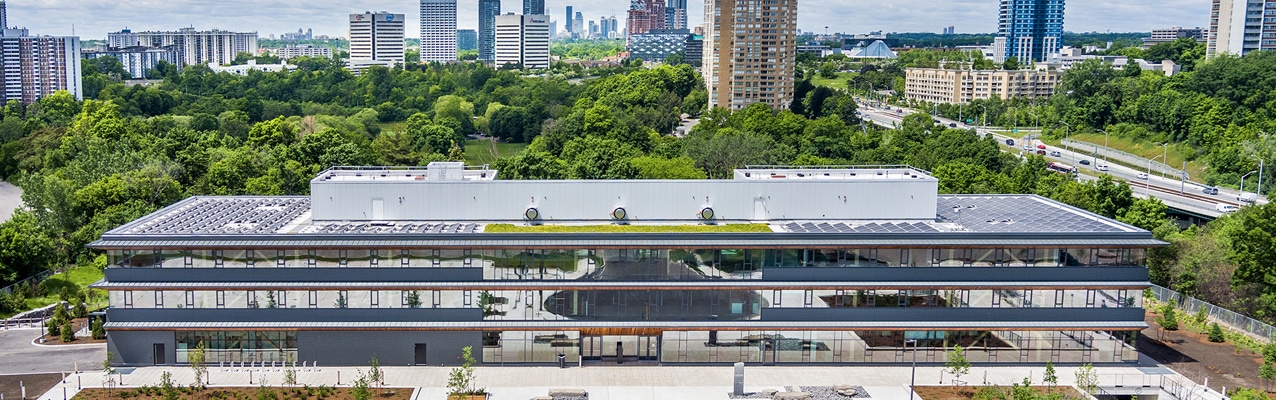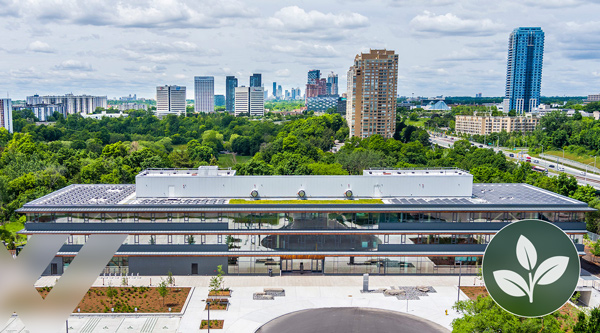
The new headquarters for the Ontario Secondary School Teachers’ Federation, designed by Moriyama Teshima Architects (MTA), marks the firm’s first completed mass timber development and represents a significant step forward for sustainable construction in Toronto. Formally titled the Ontario Secondary School Teachers’ Federation (OSSTF/FEESO) Headquarters and Multi-Tenant Commercial Building, the project delivers 127,000 square feet of mixed-use space. From the outset, the design prioritized carbon reduction, environmental stewardship, occupant health and wellbeing, and the achievement of LEED® Platinum certification. To realize these objectives, MTA incorporated materials such as laminated mass timber and AviProtek® E energy-efficient bird-friendly glass, supporting their performance and sustainability targets.
Thanks to Phil Silverstein, B.Arch., MAATO, LEED AP BD+C, GRP and Partner at Moriyama Teshima Architects for his help with this article.
- Architects: Moriyama Teshima Architects
- Fabricator: Trulite Toronto
- Glazier: Gage Aluminum
- Bird friendly markers: AviProtek® E bird friendly glass pattern 215 by Walker Glass
- Low e coating: Solarban® 90 low-e coating by Vitro Architectural Glass
- Photo credit: Philip Castleton Photography Inc.

Image courtesy of Moriyama Teshima Architects
“The mandate from the client was a low-carbon building, meaning mass timber, futureproofed, net zero operating energy building meeting Toronto Green Standard Tier 4, which no other building in the city had met. To meet that, we couldn’t leave anything on the table.”
– Philip Silverstein, B.Arch., MAATO, LEED AP BD+C, GRP, Partner, Moriyama Teshima Architecture
Achieving Net Zero Operational Carbon with a High-Performance Building Envelope
Although the OSSTF headquarters is widely recognized for its mass timber structure, the building envelope plays an equally important role in overall performance. In pursuit of net-zero operational carbon, which is one of the criteria to meet the top tier of the Toronto Green Standard version 4, MTA specified AviProtek® E glass with a Solarban® 90 low-e coating by Vitro Architectural Glass on the second surface. Because the bird-friendly markers are applied to the first surface, the low-e coating could be positioned on surface two, improving thermal efficiency without compromising bird safety. This configuration also provided greater flexibility to expand glazing areas and maximize daylight harvesting. The final composition delivers a Solar Heat Gain Coefficient of just 0.23, along with 51% visible light transmittance.
As Silverstein explained, “The heating and cooling were the largest energy loads, but what surprised us were the high lighting loads, which we had to find a way to reduce. We solved this by utilizing daylight harvesting techniques. We designed the head of the windows to be as high as possible, fine-tuned the window-to-wall ratio – in our case it was 60:40 – and placed the lighting on daylight dimming controls. These measures brought the energy required to run the lighting down by 60%. This builds in lifetime cost savings using passive solutions. The high-performance building envelope allowed us to slightly increase the window area without impacting solar heat gain.”

The OSSTF uses large bird friendly windows to increase natural daylighting and reduce the energy load required for lighting, contributing to the project goal of net zero operational carbon.
Bird Friendly Windows Protect Urban Biodiversity
The selection of bird-friendly glazing was a critical component of the design strategy. With expansive windows overlooking the Don Valley Ravine, an important ecological corridor along the Atlantic and Mississippi flyways, the risk of bird collisions required careful consideration. Furthermore, the Toronto Green Standard requires that new buildings use approved bird-friendly treatments for at least 85% of exterior glazing for the first 16m above grade.
To address this, MTA specified AviProtek® E pattern 215, composed of 5mm acid-etched dots arranged in a 2″ x 2″ grid. This tight spacing complies with both the Toronto Green Standard and the CSA A460:19 standard for bird-friendly building design. Because the markers are etched on the first surface, they remain visible under all lighting conditions, regardless of exterior reflectivity. The monolithic acid-etched treatment is integral to the glass surface, offering long-term durability against weathering and abrasion without requiring specialized maintenance.
Glass Composition
The choice of glass for this building’s large windows was an important factor in meeting the project goals. This energy efficient, bird safe composition allowed MTA to design large banks of windows without creating unmanageable heating/cooling loads or bird collision hazards. They were able to harness the additional natural light and views from these windows to reduce energy consumption for lighting and improve occupant experiences.
Glass composition: 6mm clear glass with AviProtek® E pattern 215 on surface 1 and Solarban® 90 low-e coating on surface 2.


The glass selection and the choice to increase the window-to-wall ratio at the OSSTF enhance occupant comfort by allowing for increases in natural light and scenic views of the ravine. This biophilic approach supports well-being, improves productivity, and helps regulate circadian rhythms for occupants. With a subtle bird-friendly pattern that does not affect sightlines or daylight, the windows provide a balanced solution for sustainability, comfort, and wildlife protection.
Why Select AviProtek® E Pattern 215?
During the design process, it’s important to choose a solution that not only delivers on aesthetics but also on durability, performance, and proven effectiveness. AviProtek® E pattern 215 offers:
- proven and tested bird collision deterrence
- energy efficient Solarban® low e coating on surface 2
- high visible light transmittance (VLT)
- subtle visual markers that do not impede views through the glass
- longevity and ease of maintenance – same as untreated glass
- 10-year warranty against surface degradation
Awards and Nominations
This project has already been recognized for a number of awards, including:
- Rethinking the Future Award – Office Building (Concept) Category [Runner-Up] (2023)
- LOOP Design Awards – Office Concept Category (2023)
- Architecture Press Release (APR), Global Future Design Awards – Office Building (Under Construction) Category (2023)
- LOOP Design Awards – Architecture | Offices Category (2024)
- Architecture Press Release (APR), Global Future Design Awards – Office Building (Built) Category (2024)
- Architizer A+Award – Commercial Office Category, Popular Choice (2025)
The new OSSTF headquarters pushes the limits of sustainable development through its forward-thinking design and MTA’s commitment to meet the demanding criteria of LEED Platinum and the Toronto Green Standard Tier 4. By combining mass timber construction with a rigorously engineered, high-performance building envelope, Moriyama Teshima Architects delivered a project that meets demanding sustainability goals and sets a new precedent for sustainable commercial development in Toronto.

Get more project features like this one
Our newsletter features articles on interesting projects where glass plays an essential role in the design, as well as news about architecture and the glass industry. Subscribe to join the conversation!